

Healthcare clinics today handle more data than patient histories, prescriptions, lab results, billing details, and follow-ups. Managing all of this efficiently is no longer possible with paper files or disconnected systems.
That’s where Electronic Health Records (EHR) software comes in.
Electronic Health Records software helps clinics store, manage, and access patient data digitally, improving accuracy, speed, and continuity of care.
What is an electronic health records software?
Electronic Health Records software is a digital system used by clinics to create, store, and manage patient medical records.
These records typically include:
- Patient demographics
- Medical history
- Diagnoses and treatment notes or case sheets
- Prescriptions
- Lab and imaging results
- Visit summaries and follow-ups
Unlike paper files or basic digital records, EHR software allows authorized healthcare staff to access up-to-date patient information in real time, across departments or locations.
EHR vs EMR: What’s the Difference?
EMR (Electronic Medical Record): Digital version of records within a single clinic
EHR (Electronic Health Record): Designed for broader use, sharing data securely across systems when needed.
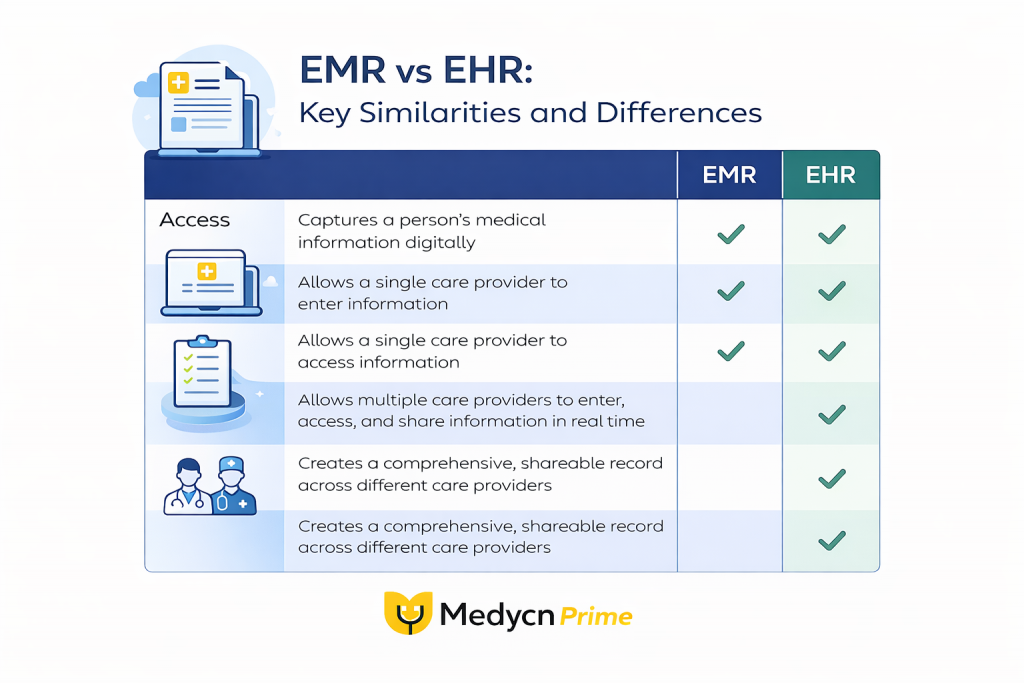
Most modern clinics now prefer EHR software due to its flexibility, scalability, and integration capabilities.
How does electronic health records software work?
In practice, EHR software supports the entire lifecycle of a patient visit; not as isolated steps, but as a connected workflow.
1. Patient intake and data capture
Accurate data entry at the first touchpoint is critical. Modern EHR systems reduce manual effort through structured forms and reusable patient profiles, ensuring consistency across visits.
2. Clinical documentation during consultations
Effective EHR platforms enable clinicians to document care while maintaining patient interaction, using templates, quick inputs, and specialty-specific workflows.
3. Orders, prescriptions, and follow-ups
E-prescriptions and digital orders reduce errors and provide traceability. Follow-up actions such as tests, referrals, or future visits should remain linked to the patient’s record.
4. Billing and reporting
When clinical and billing data are connected, clinics reduce revenue leakage and gain clearer insights into performance metrics such as visit volumes and service utilization.
This integration is where many legacy systems fall short.
Core Features That Matter in Electronic Health Records Software
From an implementation standpoint, the following features consistently determine whether an EHR system succeeds or fails in a clinic setting.
Structured patient records
Data must be searchable, consistent, and longitudinal. Not scattered across free-text notes.
Flexible clinical templates
Clinics vary by specialty, provider preferences, and patient complexity. EHR systems should adapt to workflows, not force clinics to adapt to the software.
Scheduling and visit management
Tightly integrated scheduling improves patient flow and resource planning.
Prescription and order management
Digital prescribing reduces medication errors and supports compliance requirements.
Analytics and clinical reporting
EHR data should inform decisions and not sit unused. Reports on patient trends, outcomes, and operational performance are critical.
Security and access control
Role-based permissions and audit trails protect sensitive patient information and support regulatory requirements.

Benefits of using Electronic Health Records software
Clinics adopt EHR software not just for digitization, but for measurable improvements in care delivery and operations.
- Improved efficiency: Less paperwork and faster access to patient data
- Reduced errors: Clear, standardized records lower the risk of mistakes
- Better patient experience: Shorter wait times and more informed consultations
- Continuity of care: Complete histories support better clinical decisions
- Scalability: Easy to manage growing patient volumes and additional locations
Over time, EHR software becomes a foundation for sustainable clinic growth.
Why are many clinics dissatisfied with their EHR systems?
In evaluations and migrations, the same challenges appear repeatedly:
- Overly complex interfaces that slow down clinicians
- Systems designed for hospitals rather than outpatient clinics
- High dependency on support teams for simple changes
- Limited interoperability with other tools
- Long implementation cycles with unclear ROI
These issues often prompt clinics to reconsider their EHR strategy within a few years of adoption.
Electronic Health Records Software Pricing
EHR software pricing can vary widely based on features, users, and deployment models.
Common pricing structures include:
- Per-provider or per-user pricing
- Subscription-based monthly or annual plans
- Add-on costs for advanced features or integrations
Clinics should look beyond upfront costs and evaluate:
- Implementation time
- Training and support
- Long-term usability and scalability
Lower upfront pricing does not always translate into better value. Systems that reduce friction and improve workflows tend to deliver higher long-term returns.
The right EHR software delivers value through efficiency, accuracy, and reduced administrative overhead.
How Medycn Prime approaches EHR Software?
Medycn Prime takes a modern approach to Electronic Health Records software by focusing on simplicity, flexibility, and real-world clinic workflows.
Instead of treating EHR as a standalone tool, Medycn Prime integrates patient records with scheduling, billing, and operational management by reducing the need for multiple disconnected systems and works as an all round clinic management software for your clinic.
Its cloud-based design allows clinics to get started quickly while scaling as their needs evolve.
The goal of Medycn Prime is straightforward: help clinics manage patient data efficiently without adding additional operational complexity and costs.
Simplify your clinic wisely with Medycn Prime
Electronic Health Records software is a strategic investment for any clinic.
Clinics that choose systems aligned with real clinical workflows; not just feature checklists are consistently achieving better outcomes on their ROIs.
If you are evaluating Electronic Health Records software, platforms like Medycn Prime are built to support clinics through this transition with minimal disruption and long-term operational clarity.
And if streamlining your clinic workflows feels complex, you can reach out for a guided demo walkthrough to see how a modern EHR system works in real-world practice.